
The weights shown refer to the ultra-light version. Before placing your order, please get in touch to discuss the specs and materials for your piece.
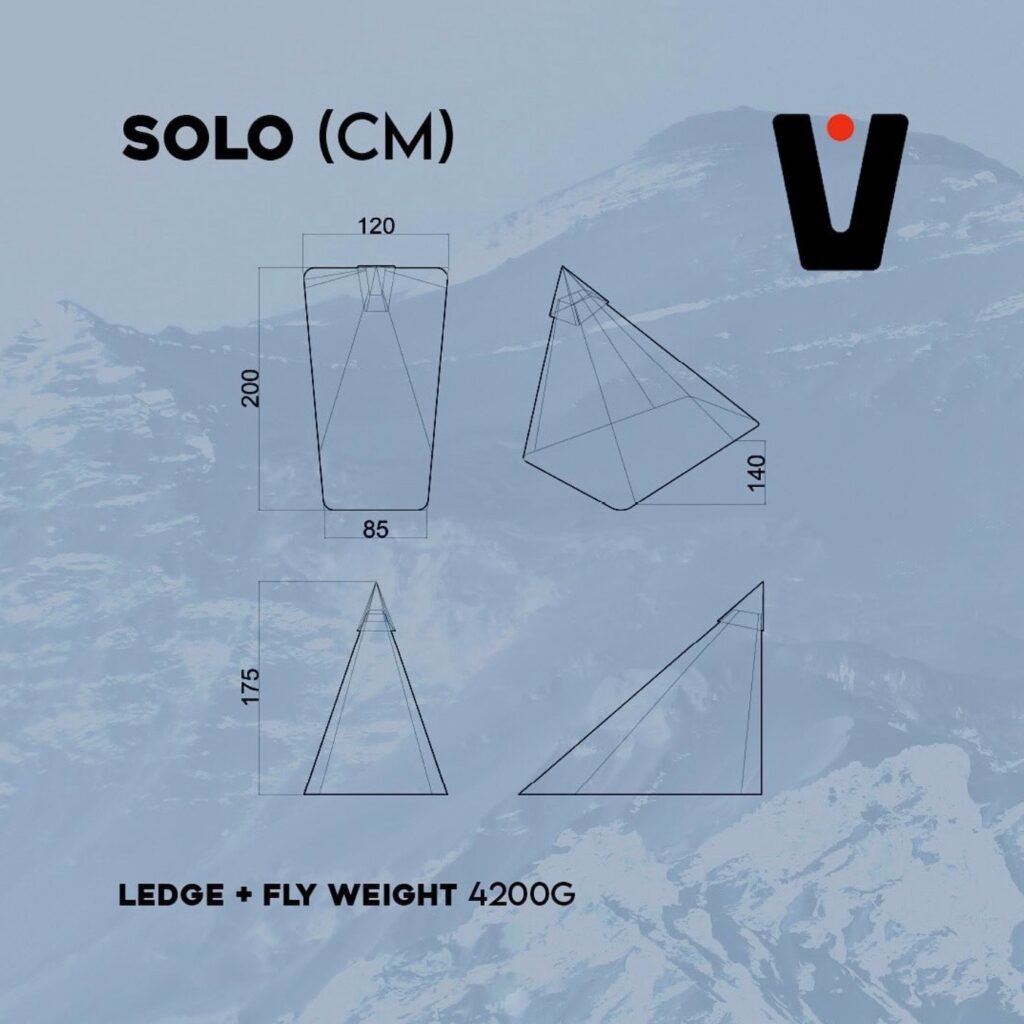
SOLO
Designed for solo climbing, but a bivi for two people is also possible.
Dimensions: length 200 cm, width 120/85 cm
Weight: ledge 3500g, fly 700g, haul sack 450g
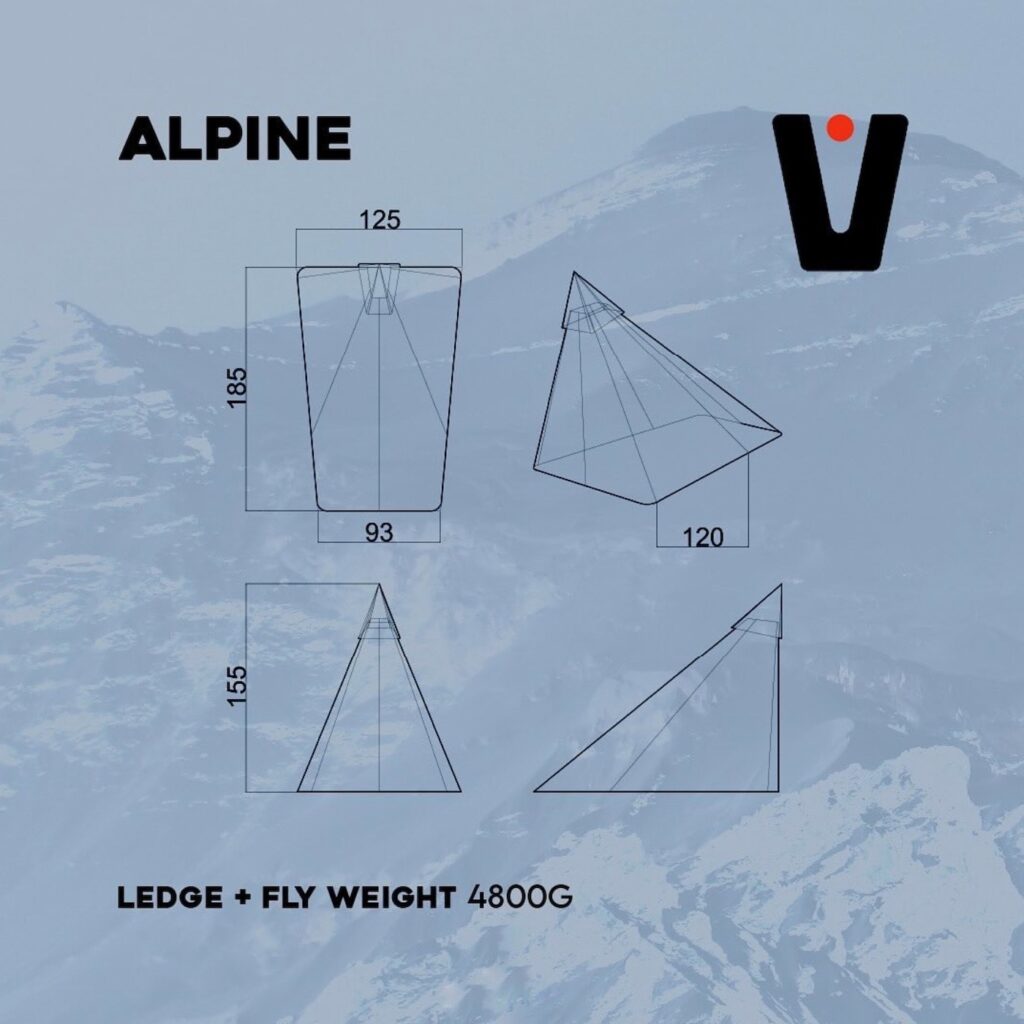
alpine
Very light, two-person portaledge, ideal for people no taller than 175 cm, for alpine walls and fast ascents.
Dimensions: length 185 cm, width 125/93 cm
Weight: ledge 4000g, fly 800g, haul sack 450g
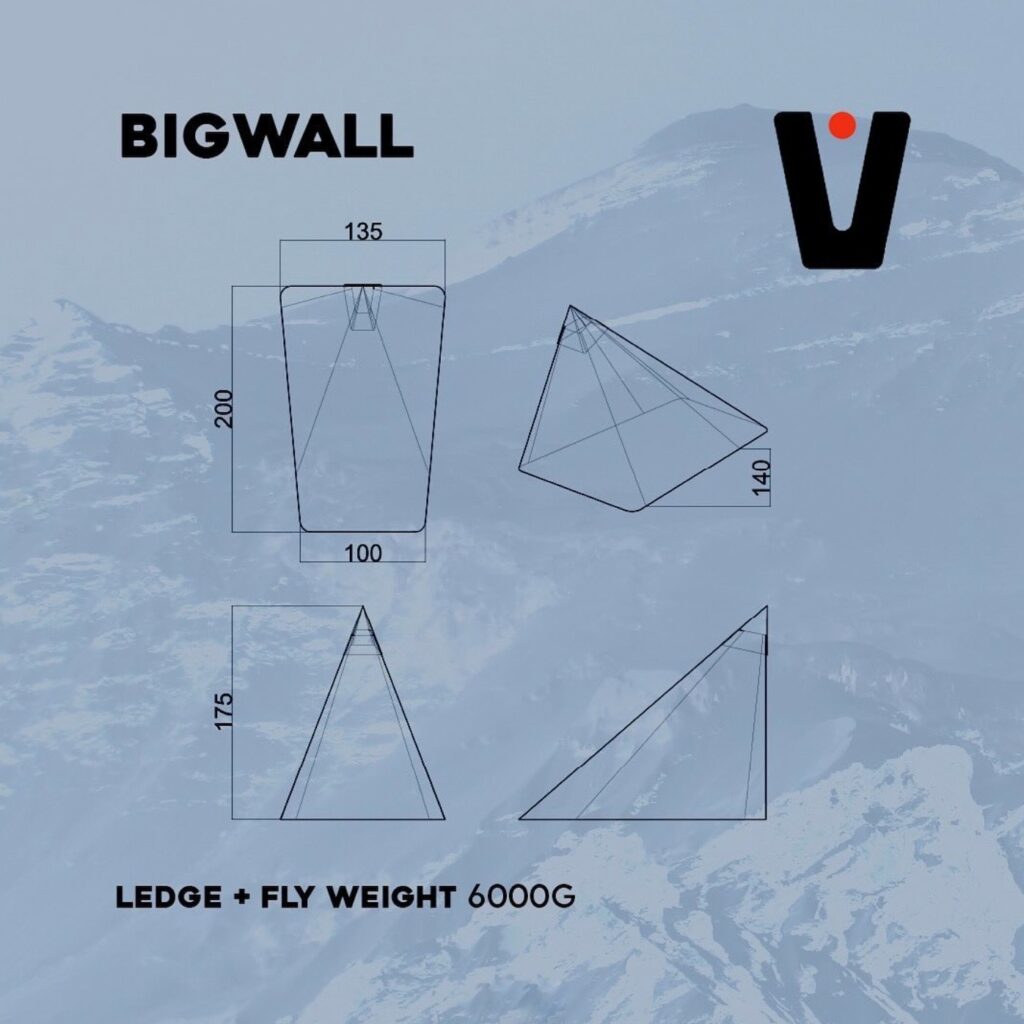
bigwall
Full-size portaledge designed for climbing in big walls.
Dimensions: length 200 cm, width 135/100 cm
Weight: ledge 4400g, fly 1600g, haul sack 450g
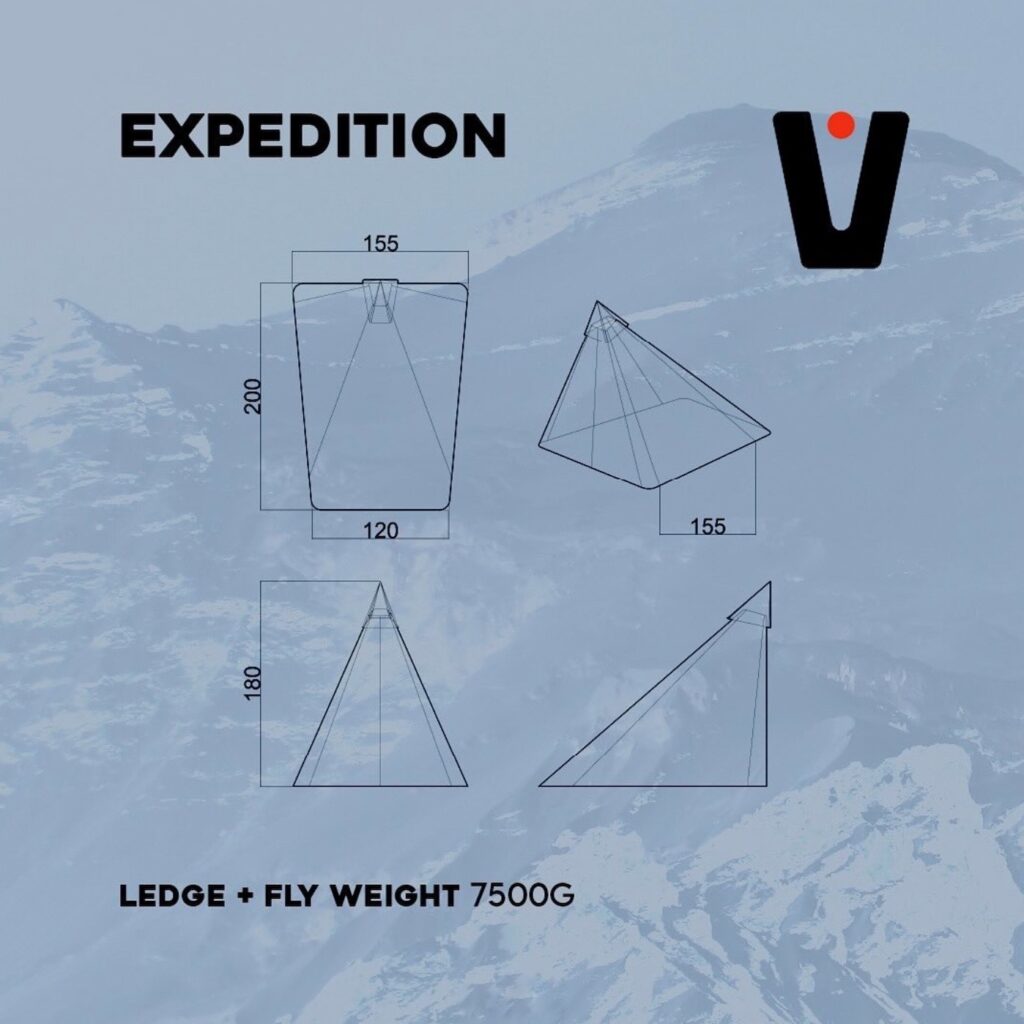
expedition
A two-person, extremely spacious model, designed for multi-day climbing in extreme winter conditions.
Dimensions: length 200 cm, width 155/120 cm
Weight: ledge 5500g, fly 2000g, haul sack 530g
F.A.Q.
There are several reasons:
- When the portaledge is hanging sideways, you have to constantly rotate inside the tight space when you are inside. First, you sit crosswise to cook and eat, then you rotate simultaneously to lie down. When someone wants to get up for any reason (toilet, reaching into the bags for food, getting off the portaledge), both people have to do it – otherwise the portal will tilt dangerously. In the V configuration, there is no such problem at all. Both people are always at the exit, it’s only one move to get from the sitting to the lying position, if one goes outside, the rotating arm is too small to tilt the portaledge.
- The V configuration allows the portaledge to be hung also on a flat wall. In the traditional configuration, the person lying on the air side is crushed by the straps.
- It is much easier to find a place where you can hang the portaledge, because it requires much less space.
- setting up the portaledge in a V-shape is much easier and faster
We use two types of aluminum:
- Straight sections: 30×1.5 mm pipe, #2024 alloy – certified high-strength “aviation” aluminum
- Bent corners: 28×2 mm pipe, #6063 alloy – medium-strength ductile aluminum. The ends of the corners have undergone diameter reduction, thanks to which the frame elements connect directly, creating a V-shaped structure. A 27×3 mm aluminum connector was used in the middle of the longest sides.
An elastic rubber cord running inside pipes keeps all the elements together when disassembled for transport.
The support frame creates a plane, without a tendency to warp diagonally (as is the case with most other portaledges).
The Vision fly is made of “ripstop” materials, which are resistant to tearing. The walls have a waterproof and vapor-permeable polyurethane coating, thanks to which, in addition to protecting against rain and wind, they also provide breathability. The tent always remains dry inside.
The wall in contact with the rock (wall) is made of Cordura 5020 PU membrane to ensure greater durability in contact with sharp edges. The fly floor (Polyester 300 D) surrounds the portaledge structure underneath, so that gusts of wind do not get inside, and even the smallest elements of your equipment will never fall out. The floor has ventilation holes secured with mesh, ensuring circulation and removal of air to the outside when rolling up the tent.
Double-sided entrances with a width of 2/3 of the entire side wall open from the top to the floor using splash-proof zippers. The tent seams have not been glued. The amount of water getting inside is so small that it is not necessary. The user can glue the seams by themselves, using products available on the market, such as Fast Cure Seam Sealant.
The floor is made of Nylon 210D UltraGrid™ ripstop reinforced with Dyneema® mesh. This material is partially used in two layers. The floor is tensioned on the frame using 4 straps, two of which are applied to the frame without slipping out of the buckles, which makes setting up easier and faster.
No. You put the tent on the hanging portaledge, without leaving it. You start from the air side, putting it on like a sweater on your head. When you reach the wall, you have to sit with your back to the air, and push off the wall with your feet so as to create a gap between the frame and the rock, and through this gap, slide the back (wall) of the tent from the bottom up. Then you can fasten the zippers and the tent is ready. It will take a maximum of 5 minutes.
Remember that no portaledge is an element of the belay system, therefore its strength should be described as “0 kN, only body weight”. When in the portaledge, you must be tied directly to your belay at all times.
Vision has been tested under a static, total load of 400 kg and also repeatedly in the wall under the load of 2 climbers with equipment, exceeding a total of 160 kg. The strength of a single strap is 180 kg. You should not stand with your full body weight directly on the aluminum frame, between the straps. In extreme cases, this may break the frame.
After setting up, during adjustment, only one person can stay inside. The portaledge should be loaded as evenly as possible. On the “air” side, the portaledge should not be loaded with the weight of more than one person.
The rock on which the set-up portaledge rests should be as even as possible and the support points should be distributed along the entire edge. These can also be two support points located near the corners. It is unacceptable to lean the portaledge on a single point halfway across its width. This could break the “wall” pipe.
The portaledge works best in a vertical wall. It can also be hung safely in overhangs and on the wall with a slope up to 60 degrees. The smaller the angle of inclination of the wall in which the portaledge is hung, the greater the forces acting on the structure.
Yes. There are several safeguards. The corners of the “wall” frame of the portaledge are protected by spiral PVC overlays. The floor has a sewn-in reinforcement made of tape where it touches the rock. The tent is equipped with CORDURA 770 DTEX protectors, attached with Velcro, so they can be easily dismantled for repair or replacement.